 ΔTrace Labs
Educational research note
Weekend volume is lower across the liquid Binance names
In plain English · the 60-second version
The question. Do BTC, ETH, XRP and HYPE all trade less on weekends?
The result. Yes. For the three spot coins weekends average 65% (BTC) to 70% (ETH, XRP) of weekday volume across 2019–2025, and HYPE futures show 69% on a short 2025 sample. The gap has widened since 2021.
Caveats. It is a liquidity fact, not a trading rule. To learn whether weekends matter for a strategy you would have to test that strategy with and without weekend entries, including fees and slippage.
Scope. Consistent across coins, but descriptive: it documents a liquidity pattern, not a strategy result.
Bottom line: All the big coins are quieter on weekends, roughly two-thirds to 70% of weekday volume, and the gap has grown.
Jargon decoder
- Volume
- How much of an asset was traded. High volume = busy, easy to trade; low volume = quiet and thinner.
- Weekend / weekday
- Average weekend volume divided by average weekday volume. 65% = weekends are about two-thirds as busy.
- Perpetual future (perp)
- A futures contract with no expiry, used to bet on price with borrowed exposure.
Summary
BTC, ETH and XRP spot all print lower weekend volume on Binance: weekends average about 65%–70% of weekdays across 2019–2025. That is a liquidity fact, not a rule about when to trade.
The gap is persistent and broadly widened after 2021. HYPE is a short USD-M futures sample and is not pooled with the multi-year spot conclusions.
Key figures
Evidence
In plain English
The year table shows the weekend gap getting wider for all three spot coins after 2021 (BTC from about 78% to about 47–52%). HYPE is shown for reference only because it is a short futures sample.
Headline weekend ratio
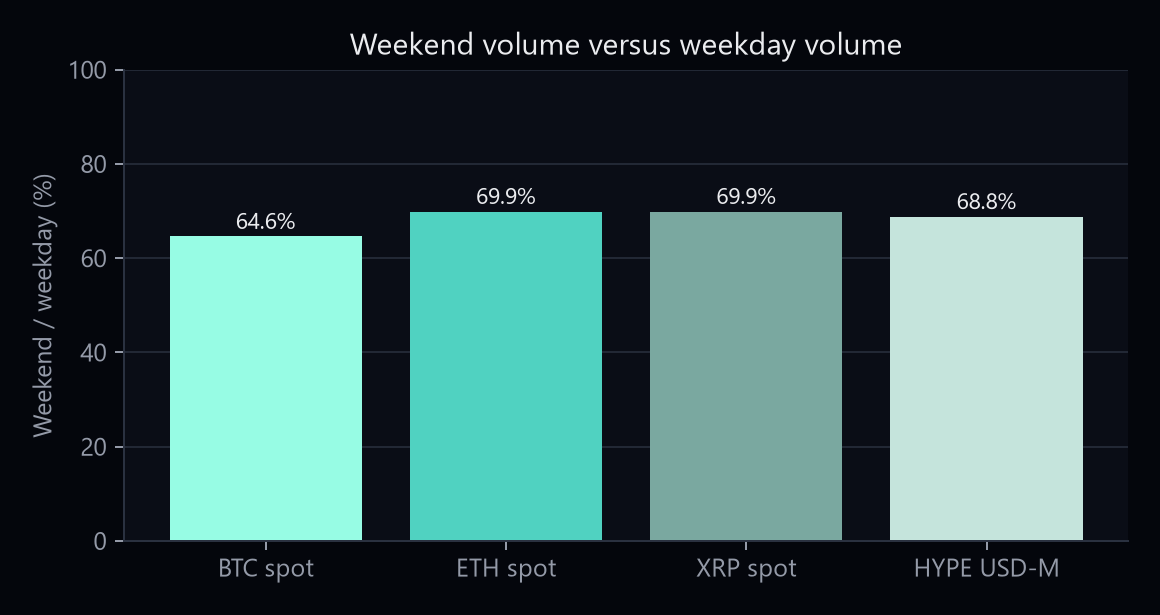
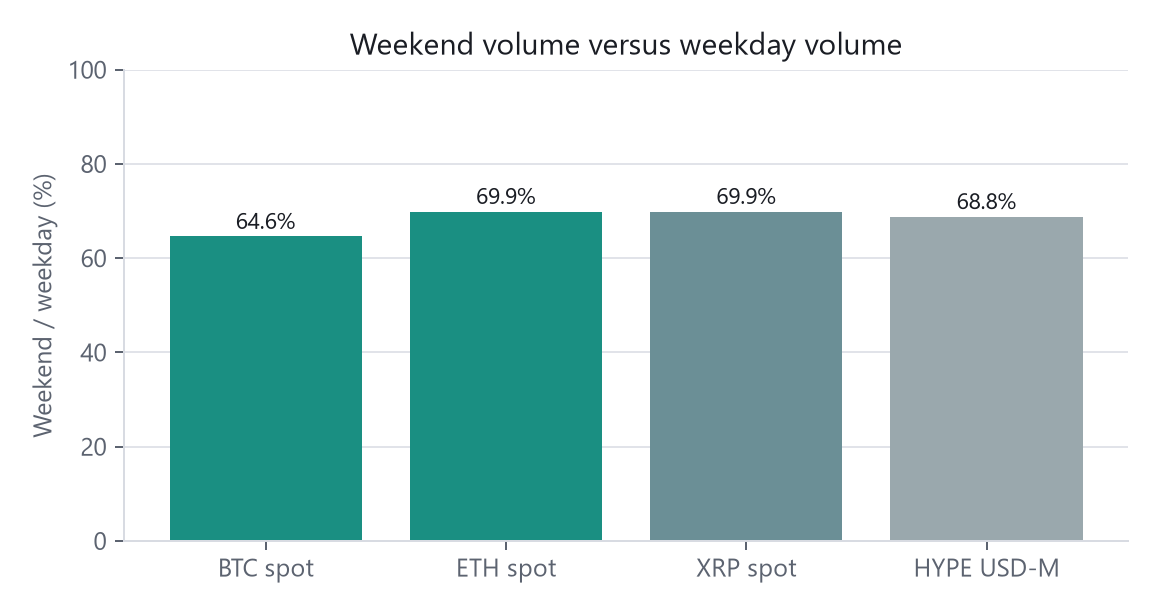
Mean base-asset volume. USDT pairs are USD proxies because they are the liquid Binance pairs with public archive history. HYPE has no comparable Binance global spot archive.
| Asset | Series | Coverage | Daily candles | Weekend / weekday | Shortfall |
|---|---|---|---|---|---|
| BTC | BTCUSDT spot | 2019–2025 | 2,557 | 64.6% | 35.4% |
| ETH | ETHUSDT spot | 2019–2025 | 2,557 | 69.9% | 30.1% |
| XRP | XRPUSDT spot | 2019–2025 | 2,557 | 69.9% | 30.1% |
| HYPE | HYPEUSDT USD-M | May–Dec 2025 | 216 | 68.8% | 31.2% |
How the spot weekend gap changed
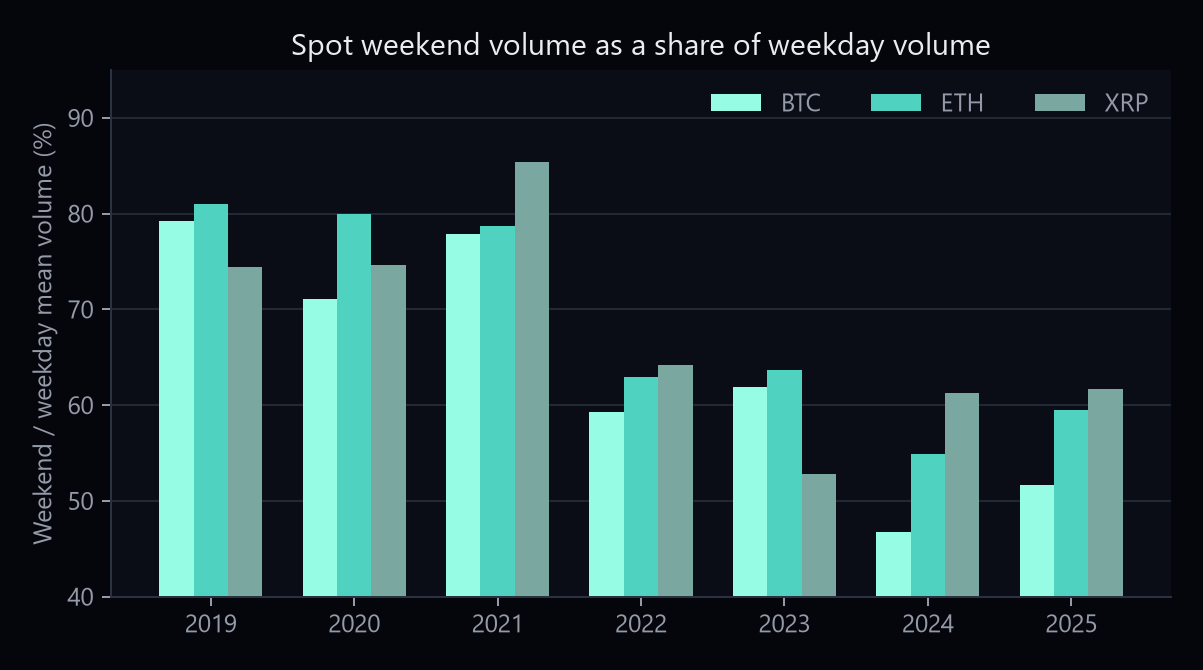
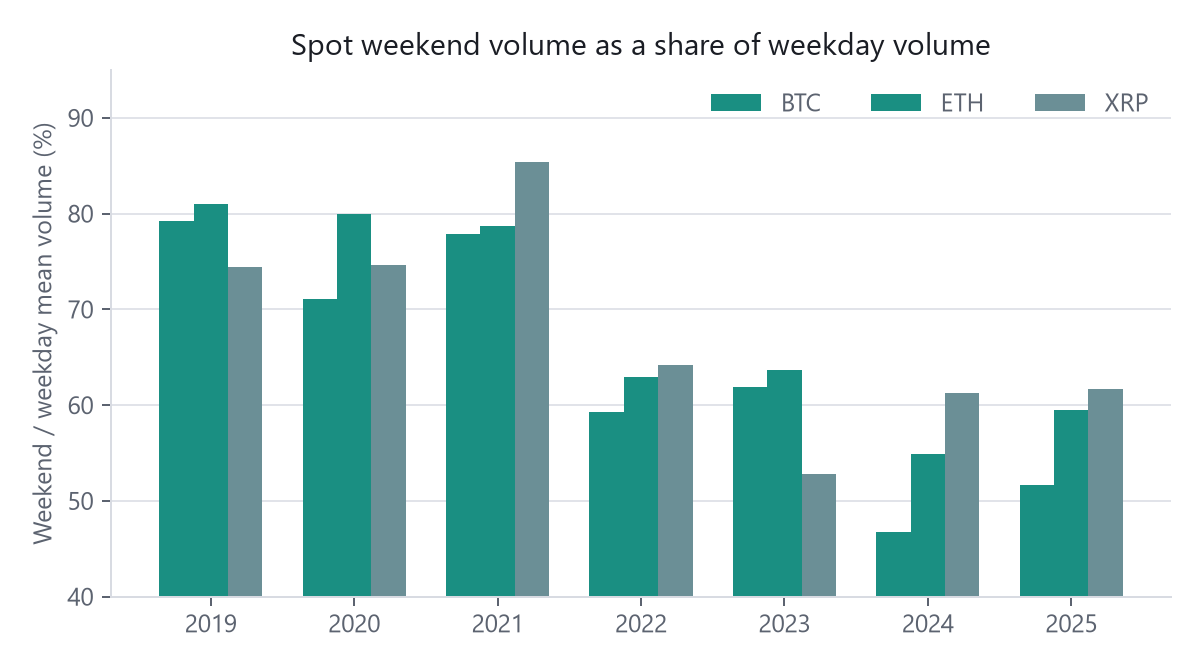
Each number is weekend mean divided by weekday mean base-asset volume. The lower weekend activity is persistent and broadly widened after 2021.
| Year | BTC spot | ETH spot | XRP spot |
|---|---|---|---|
| 2019 | 79.2% | 81.0% | 74.4% |
| 2020 | 71.1% | 80.0% | 74.7% |
| 2021 | 77.9% | 78.7% | 85.4% |
| 2022 | 59.3% | 62.9% | 64.1% |
| 2023 | 61.9% | 63.7% | 52.8% |
| 2024 | 46.8% | 54.9% | 61.3% |
| 2025 | 51.7% | 59.5% | 61.7% |
Per-asset notes: BTC · ETH · XRP · HYPE futures.
Caveats
Notes are educational. They are not investment advice and they do not recommend trades. Historical or simulated results are not a live track record.
This is evidence of a weekend liquidity regime, not evidence that avoiding weekends improves a strategy. Test the actual rules with and without weekend entries, including fees, order size, spreads and slippage. HYPE futures should not be pooled with the multi-year spot conclusions. Source: Binance Data Collection monthly 1d kline archives, SHA-256 verified.
Disclaimer
- ΔTrace Labs is a personal portfolio and research project, not a registered fund, asset manager, broker, exchange, advisory business or licensed virtual-asset service provider.
- It does not manage external capital, accept deposits, provide investment advice, sell signals or offer client trading services.
- Named platforms and evaluation programmes, including Propr, Hyperliquid, Lucid Trading and Tradeify, are not employers or formal affiliates.
- Research on this site is educational and is not a recommendation to buy, sell or hold any instrument. Historical or simulated results are not a live track record.
- No returns, assets under management, clients, partnerships, testimonials or performance figures are claimed unless they can be evidenced. Published indicators are listed only when a public URL exists.