 ΔTrace Labs
Educational research note
Funding, hold time and the counterparty layer
In plain English · the 60-second version
The question. What does 'funding' cost on perpetual futures, and does it matter for fast, high-turnover trading simulations?
The result. For someone holding a 1x BTC long on Binance from 2020 to 2026, funding added up to 78.7% of the position size (about 11.8% a year). For the simulated fast-trading book, which holds trades for 15–30 minutes, funding was only about $15k versus $3.18M in taker fees, about 0.3%. For fast trading, fees and slippage are the cost that matters.
Caveats. The figures come from a simulation, not real trading, and the funding overlay is a lower bound. SOL's net funding is near zero but the two-way flow is large (about 146% of position size across both signs), which is a risk for whoever sits on the other side. The note also discusses a third party's no-funding product from public descriptions only; it doesn't test it.
Scope. Figures are simulated and the funding overlay is a lower bound. The comparison with the third-party product rests on public materials and is out of sample.
Bottom line: Holding a perp for long periods costs real money in funding, but for trades lasting minutes funding barely matters; fees and slippage do.
Jargon decoder
- Perpetual future (perp)
- A futures contract with no expiry, used to bet on price with borrowed exposure.
- Funding
- A periodic payment between longs and shorts on perps that keeps the perp price near spot. Usually longs pay shorts when the market is bullish.
- Notional
- The full size of a position. Funding of 1% of notional on a $1,000 position = $10.
- Taker fee / slippage
- Taker fee: what an exchange charges for taking an order from the book. Slippage: the worse price you get because the market moves as you trade.
- Simulated
- A replay of rules on past data with assumed fees and fills. Not real trades and not a live track record.
Summary
On a classic perpetual, funding is a transfer between longs and shorts on open notional. It is large for a 1x holder and almost invisible for a book that is only open for minutes.
A pitch that treats long and short as wallet tokens, with no funding print and no liquidation engine, is aimed at the first of those two users. This note splits the cost stack we already measured — taker fees and modelled slip — from the funding overlay that the original engine never applied, and places both next to a continuous 1x carry on BTC, ETH and SOL. Named venues are data sources, not affiliates. Nothing here is a recommendation to use or avoid any protocol.
Key figures
Two occupancies, two cost stories
In plain English
Funding is only charged on positions open at the payment time. A trader who holds for days pays it often; one who holds for 15 minutes almost never does. Same rates, very different totals.
Funding accrues on notional that is open at the print. A directional token you can sit in is occupied for days to years. A stop-break campaign in this sample is typically occupied for one signal bar plus a short management window. Same rate series; different integral.
The original replay charged 4.5 bps taker per fill and 3 bps modelled slip on entries and stops. It did not charge funding. That gap is now filled in compute_funding_overlay.py in this folder, without rewriting the frozen autopsy files.
Evidence: 1x holder carry
In plain English
'Paid' is the sum of funding a long paid out on positive prints, and 'received' is what it got back on negative ones. Net = paid minus received. BTC and ETH were mostly paid out; SOL nearly cancels (73.6% paid, 72.6% received).
Sum of published funding rates, long-only, as a fraction of notional. Positive prints are a debit to the long. This is the cost a no-funding 1x token claims not to charge the holder. It is not a protocol backtest of Reperp, whose AMM, oracle and pool rules are not in this sample.
Cumulative funding on a continuous 1x long
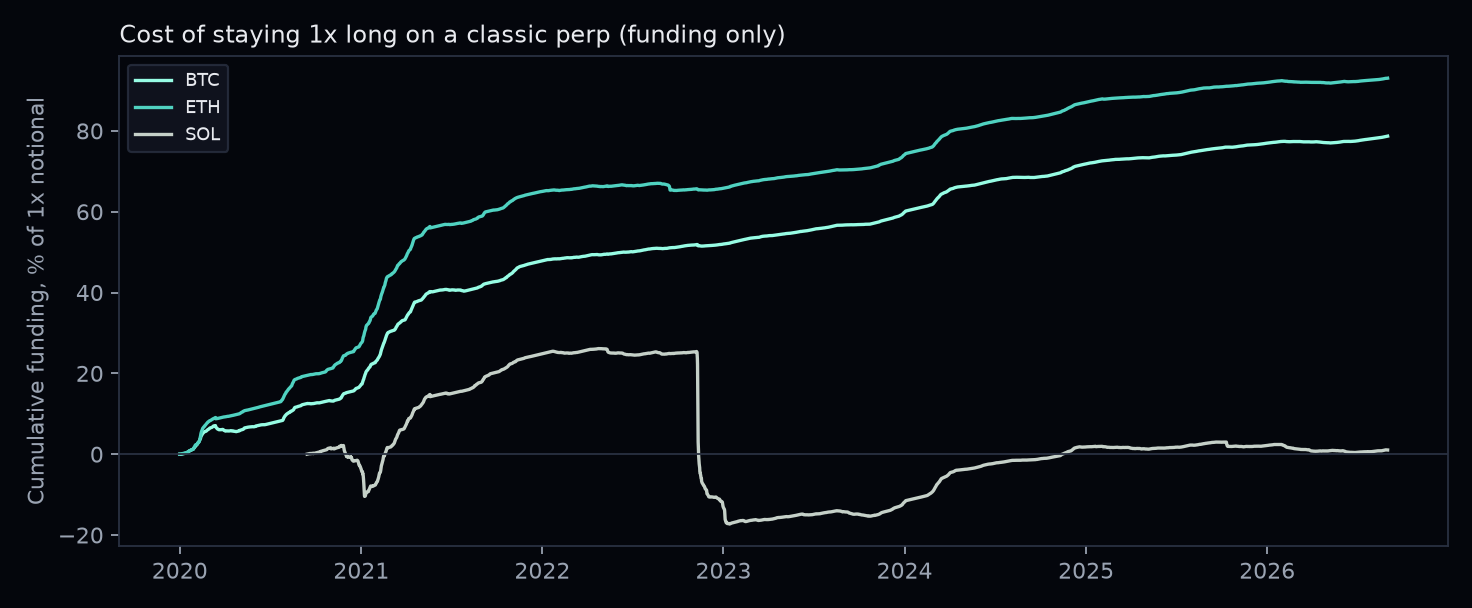
Source: data.binance.vision USDT-M fundingRate archive · BTC/ETH Jan 2020–Aug 2026 · SOL from Sep 2020 listing · each print added to a unit notional · not a trading rule
| 1x long | Net carry | Paid (pos prints) | Received (neg prints) | Implied ann. if mean held |
|---|---|---|---|---|
| BTC USDT-M | +78.7% | +85.4% | −6.7% | 11.8% |
| ETH USDT-M | +93.0% | +100.4% | −7.3% | 14.0% |
| SOL USDT-M | +1.0% | +73.6% | −72.6% | 0.2% |
SOL is the instrument in the public pitch. Net carry on SOL is near zero in this archive because the two sides almost cancel. The two-way flow is not small: longs paid 73.6% of notional across positive prints and received 72.6% back across negative prints. A shared counterparty pool still has to warehouse that oscillation even when the holder’s net invoice looks flat.
On Hyperliquid’s hourly series for 1 Jun–19 Sep 2026 the same 1x long paid 2.41% (BTC), 2.29% (ETH) and 1.32% (SOL) of notional — roughly 4–8% annualised on this short window, with SOL again the milder of the three.
Evidence: high-turnover book overlay
In plain English
For the simulated fast book the total costs were $3.18M fees plus $1.79M slippage against only $14.7k of funding, so removing funding changes the result by a rounding error.
Same rate series, applied only while a simulated campaign was open. Entry is one signal bar before the first recorded exit. Longs pay positive funding. Binance 8-hour prints on the 7-year book; Hyperliquid hourly prints on the 2026 native window.
Fees and slip versus the funding overlay
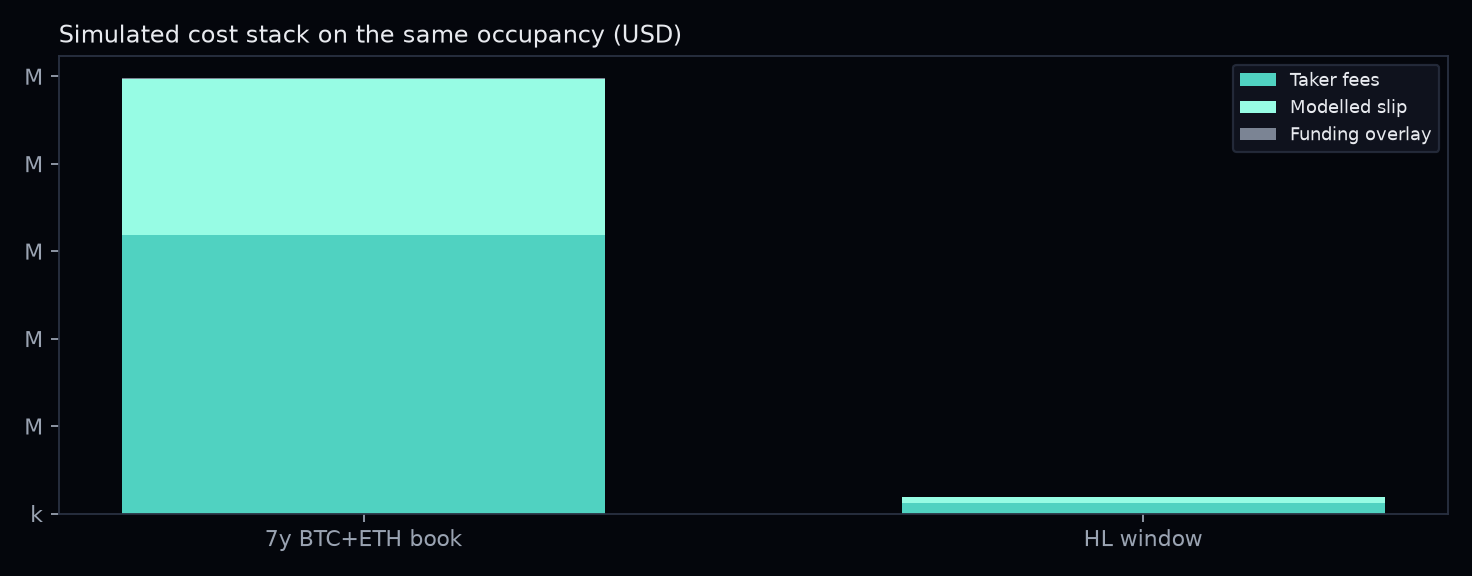
Taker fees and slip from the existing simulated replay (entry plus exit) · funding from this overlay · 7y window 2020-02-12 to 2026-09-10 · HL window 2026-07-25 to 2026-09-11 · not a live track record
| Sample | Taker fees | Slip (model) | Funding overlay | Funding / friction |
|---|---|---|---|---|
| 7y BTC+ETH | $3.18M | $1.79M | $14.7k | 0.3% |
| HL window | $120k | $65k | $421 | 0.2% |
Median hold is 0.25 hours on M15 and 0.50 hours on M30. Only 3–8% of 7-year campaigns intersect an 8-hour Binance print. Removing funding from this occupancy changes the simulated total by a rounding error. Removing taker friction would not.
Where this sits next to a tokenized 1x perp
In plain English
The note's argument: a product that charges no funding doesn't make the cost disappear; it moves into pool fees, spreads or liquidity-provider losses. This reading is based on public materials and is not verified.
Public materials for Reperp describe long and short as liquid tokens, settled from a signed price, traded in AMM pools, with no funding print, no liquidation engine and no order book, plus a shared pool meant to absorb net hedging demand. This note does not verify those mechanics. It only measures the cost layer that description removes, and the cost layer it does not.
| Layer | Classic perp (this sample) | What a no-funding 1x token relocates |
|---|---|---|
| Hourly / 8h transfer | Longs pay shorts when the print is positive | Off the holder’s invoice; still has to land in a pool, fee, or LP mark |
| Two-way SOL flow | Net ~1%, gross transfer ~146% of notional over the archive | The interesting risk is the oscillation, not the net |
| Liquidation engine | Not modelled here (risk was a dollar stop, not maintenance margin) | If 1x tokens cannot be liquidated, convexity sits with the pool |
| Order-book taker + slip | Dominant on the simulated stop-break occupancy | Reappears as AMM spread, impact, and LP PnL unless the pool is the product |
If the missing product is a holder/hedger who wants 1x SOL in a wallet, the 1x carry table is the relevant comparison. If the missing product is a high-turnover taker, this sample says funding was never the binding cost.
Caveats
Notes are educational. They are not investment advice and they do not recommend trades. Historical or simulated results are not a live track record.
Funding overlay uses one signal bar of lead before the first exit; true entry can be earlier on runner campaigns, so overlay dollars are a lower bound. Leg files store exit time, not fill time. 7-year fees in the stack include entry and exit; the overlay script’s per-book fee column is exit-side only and should not be mixed with the stack totals. Binance SOL listing begins Sep 2020. Hyperliquid prints are hourly from 1 Jun 2026. Reperp AMM depth, oracle, redemption and pool PnL are out of sample. ΔTrace Labs is not affiliated with Reperp, Binance, Hyperliquid or Propr.
Disclaimer
- ΔTrace Labs is a personal portfolio and research project, not a registered fund, asset manager, broker, exchange, advisory business or licensed virtual-asset service provider.
- It does not manage external capital, accept deposits, provide investment advice, sell signals or offer client trading services.
- Named platforms and evaluation programmes, including Propr, Hyperliquid, Lucid Trading and Tradeify, are not employers or formal affiliates.
- Research on this site is educational and is not a recommendation to buy, sell or hold any instrument. Historical or simulated results are not a live track record.
- No returns, assets under management, clients, partnerships, testimonials or performance figures are claimed unless they can be evidenced. Published indicators are listed only when a public URL exists.